'If people want to work 90 hours, we should let them work.' 'If people want to work 30 hours, you should let them work 30 hours.' 'But they should not expect the same level of success and attention.'

Several CII defence committee members confirm this is now the official CII position, which conforms to that of industry bodies, Ficci and Assocham.

While the corporate sector has benefited from massive capital expenditure, leading to sky-rocketing stock prices, investors would do well to keep an eye on the macroeconomic picture and government finances, not just corporate profits, for signs of trouble, alerts Debashis Basu.
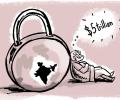
Chief Economic Advisor V Anantha Nageswaran on Thursday expressed hope that the economy will maintain the trend growth rate of 6.5 per cent and above for the rest of the years in the current decade. The economy will close the current fiscal logging in a growth of 6.5-7 per cent, he said, citing the projections of private sector analysts, Reserve Bank of India (RBI) and international agencies like OECD and the IMF. "This appears to be reasonable at this point in time although we will get the data on the fiscal second quarter in a few days, which will give more clarity on these numbers.
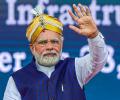
He observed that the 21st century India belongs to wealth and job creators and innovators, who are the country's true strength.

'Investors looking at the next 6-12 months can be certain that the Fed will maintain its easing cycle, and we expect the overall environment to be conducive for fixed income investments for portfolio diversification.'

A massive data breach that has implications for national security was unearthed by the Cyberabad Police in Hyderabad, who arrested seven people of a gang allegedly involved in the theft and sale of sensitive data of the government and important organisations, including details of defence personnel as well as the personal and confidential data of about 16.8 crore citizens.

Defence experts want defence expenditure to be at 3% of GDP, which they consider minimum to counter the two-front threat from China and Pakistan, internal insurgencies, and dominating a 7,500 km coastline and the Indian Ocean beyond. What Arun Jaitley has given India this Budget is 2.16% of GDP, observes Ajai Shukla.

'We have essentially tried to set out an agenda for the next five years and it, in essence, represents the political commitment to that agenda.'
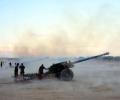
The Indian Army is enhancing the combat prowess of its artillery units along the frontier with China by procuring an array of weapons systems, including an additional batch of 100 K9 Vajra howitzers, swarm drones, loitering munitions and surveillance systems.

The Defence Acquisition Council on Wednesday approved proposals worth Rs 4,444 crore, including the purchase of four helicopters for survey vessels at Rs 2,324 crore, but deferred a decision on a joint bid of Tata Sons Ltd and Airbus for replacing IAF's Avro transport fleet.
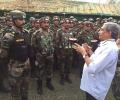
'A month after assuming charge, Parrikar promised a policy within six months to "end or at least reduce" terrorist infiltration across the Line of Control.' 'However, infiltration continued apace, leading to high-profile terrorist attacks in Gurdaspur, Pathankot, and Uri.' 'During this phase, he made the controversial suggestion that India should fight terror with terror, hinting at supporting terror groups to strike in Pakistan,' observes Ajai Shukla.
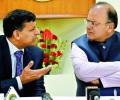
The crisis in Indian banking has now reached a point where the NPAs of many public-sector banks are higher than their net worth

Exim Bank pointed out that recent performance of the manufacturing sector in India is indicative of an underlying inertia.

The policy was part of the Aatmanirbhar Bharat package announced by Sitharaman in May 2020 as a coherent policy where all sectors would be opened for private sector participation.

The govt hiked defence budget by 7.81 per cent over last year's Rs 2.74 lakh crore.
.jpg)
Barring one, three are debt-free and sitting on large cash reserves.

Defence Minister Rajnath Singh on Thursday released the third list of over 101 military systems and weapons that will come under an import ban over the next five years and be developed indigenously, in a fresh impetus to the Indian armament industry.

The Ministry of Defence has decided to retain decades-old barriers against allowing India's private sector a meaningful role in defence production. Minister of State for Defence Production MM Pallam Raju has revealed that the MoD had scrapped its plan to nominate leading defence players from the private sector as Raksha Udyog Ratnas (RuRs), or Champions of Defence Industry, thus granting them the same status as Defence Public Sector Undertakings (DPSUs) and Ordnance Factories

Defence forces, who were last month excluded from the list of agencies eligible to procure jammers, have now been included, in addition to central armed police forces like Central Reserve Police Force, Central Industrial Security Force and Indo Tibetan Border Police.

With general elections on the horizon, the government's privatisation bandwagon has almost but stalled as a government wary of being accused of selling family silver opts for minority stake sales on stock exchanges over outright privatisation. The result -- the divestment target for current fiscal year is again likely to be missed. Big ticket privatisation plans such as that of Bharat Petroleum Corporation Ltd (BPCL), Shipping Corporation of India (SCI) and CONCOR are already on the backburner and analysts feel meaningful privatisation can happen only after April/May general elections.

Prime Minister Narendra Modi Wednesday said the International Monetary Fund (IMF) sees India as a "bright spot" in the global economy and as per the World Bank, India is in a better position to deal with the global headwinds than many other countries. This is because of India's strong "macroeconomic fundamentals", Modi said while virtually addressing the inaugural function of the 7th edition of Invest Madhya Pradesh-Global Investors Summit in Indore. In the past eight years, the government has increased the speed of reforms and removed many hurdles in the way of investments.

The defence ministry is shooting to achieve an annual export target of $5 billion by 2025.

The defence minister has 20 months to learn the military's ethos, culture and to publicly bat for an organisation that feels increasingly marginalised and underappreciated.

If a citizen chooses not to use Aadhaar as the default unique identity, then other unique identity proofs masked and linked to Aadhaar would be used.

Most brokerages are betting that the new government will shift to a policy focussing on boosting rural incomes and consumption since that has clearly been a pain point.

E-commerce players may soon rent out drones, so you can use them the way you book a cab on an app, and test viable use-cases for last-mile delivery.

'Historically, the markets tend to perform well during election years as governments aim to increase spending and call attention to growth.'

GSOMIA does not cover the exchange of classified information with Indian private industry. Washington wanted this covered too, given New Delhi's emphasis on the proposed 'strategic partnership' model of procurement.

Anil Ambani will take over as the chairman of Pipavav Defence
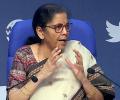
In her fourth tranche of the economic package, she said commercial mining will be done on revenue sharing mechanism instead of the regime of fixed rupee/tonne.
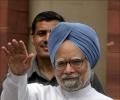
As CAG found Reliance Industries was being favoured in gas exploration deal to the government's detriment, former Prime Minister Manmohan Singh told the then top auditor Vinod Rai that audit should not hurt the private sector and RIL was one of the biggest and most respected.

The respondents were from over 22 states with 85 percent of them being under 35 years while 61 percent were interns or postgraduate trainees.

A peek into the life of a public-sector banker who did well professionally, but paid a price for it, points out Tamal Bandyopadhyay.
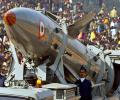
Will private firms really boost Make in India in the defence sector? Ajai Shukla seeks answers.
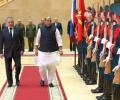
But private Indian defence firms prefer to do business with the West. Indian CEOs say they encounter difficulties in obtaining full and timely payment from Russian partners.

Admiral Puri says it would be wasteful to buy a foreign helicopter, pay for transfer of technology, and develop manufacturing capability in an Indian private sector strategic partner when all this already exists with HAL.

'Expectations are high regarding the change in LTCG with respect to equity investments.'

The Indian Medical Association states that cases are likely to rise further before coming down in Kerala as about 50 per cent of its population is still susceptible to the virus.

In less than two months since the announcement in March, the state has mobilised an armada of small and medium enterprises keen on making components for large equipment manufacturers.
